
Brand & Communication
How to choose a marketing agency: eight questions to ask before you sign

A marketing agency is an outside team that does the brand, content, advertising and analytics work in your place or alongside your own people. A polished pitch is only a starting point: you also need to understand the team, scope, measurement and terms.
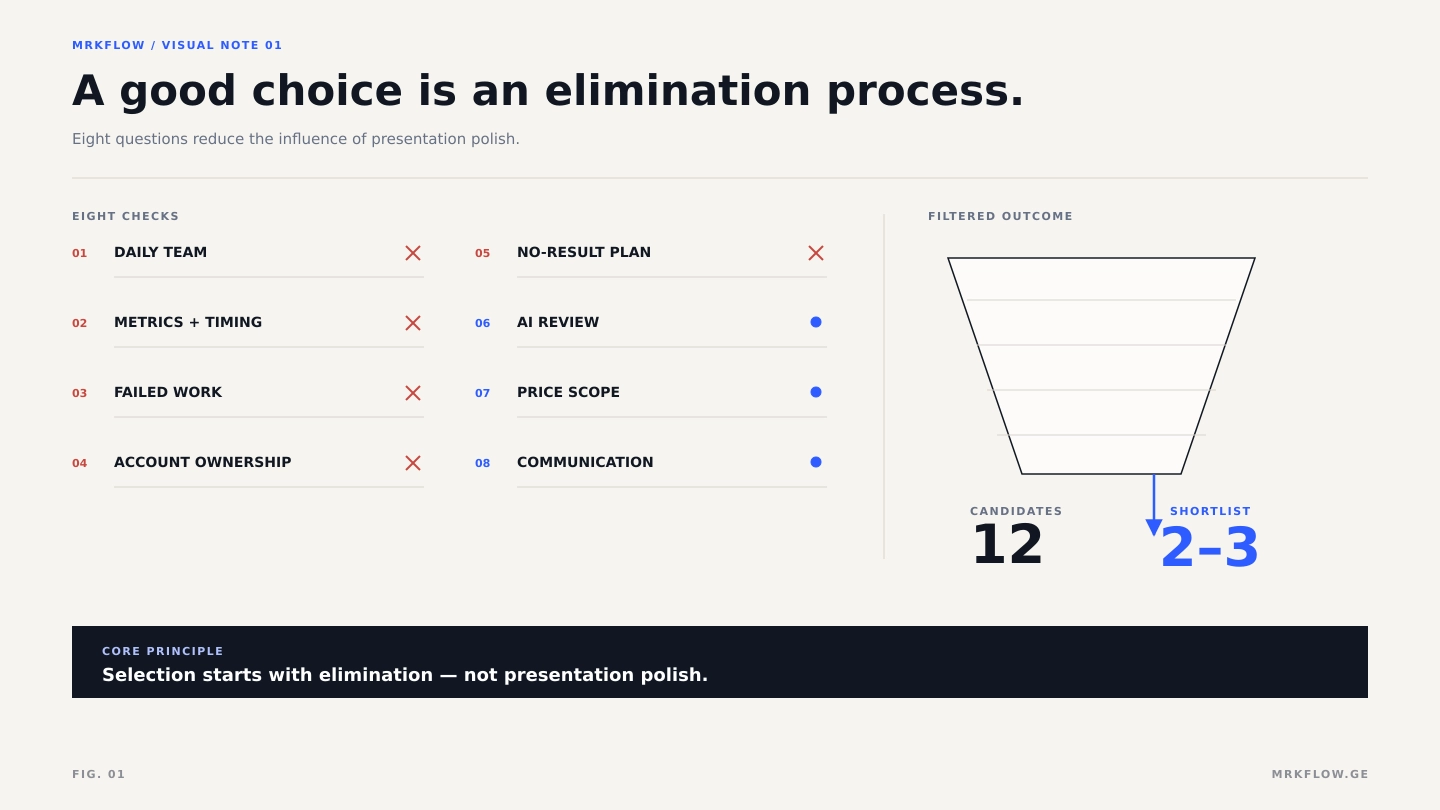
The eight questions below exist so you can see the difference before or beneath the presentation. They are deliberately uncomfortable, including for us.
1. Who will work on this every day
The founder or the strategist may be the person in the meeting, while somebody else does the daily work. Ask for names, roles, and how many other clients those people carry at the same time. Dodging the question is already an answer.
2. What will you measure, and when
"We will raise awareness" needs a defined audience, baseline, metric and timeframe before it becomes a measurable objective. Ask which two or three numbers they will watch in the first three months, and which of those connects to revenue. If the proposed metrics are dominated by likes and impressions, you are agreeing to activity rather than to a result.
3. Show me a case where it did not work
This question says a lot. Be wary of a team that says nothing has ever gone wrong. A good answer sounds like this: here is what did not work, here is why, and here is what we changed in the process afterwards.
4. Who owns the accounts and the files
Ad accounts, analytics, the domain, the social pages and the source files should be yours, with the agency holding access. If it is the other way round, ending the relationship means losing the history, the audience and the learning. This belongs in the contract, not in a meeting.
5. What happens if there is no result after three months
Ask what leaving looks like: notice period, what happens to unfinished work, what happens to money already paid. An agency that handles that conversation calmly is confident in its own results. An agency that changes the subject is selling a long contract rather than an outcome.
6. What is done with AI, and who checks it
Ask whether the agency uses AI, which tasks it supports, what information is shared with the tools and who reviews the output. If AI is used, clarify who checks facts before publication. The useful comparison is the quality and accountability of the process; AI use alone does not establish either.
7. What is included in the price and what is not
Ask for the price broken down: working hours, media budget, production, licenses and tools, each on its own line. One unpleasant surprise to rule out is a media budget that one side assumed was inside the fee and the other did not.
8. How and how often will you report
Ask how often you receive a report, in what form, and who you can reach when a question comes up mid-week. The quality of communication shows itself in the first month.
One question that is not worth asking
"How many clients have you worked with" is not the question to lead with. A client count does not tell you whether the work involved brief projects or sustained partnerships. Ask instead how long the average client stays. That one number says more than an entire portfolio.
If the list looks long
You do not need all eight in one meeting. Three will do: who works on it daily, what you will measure in three months, and show me a case where it did not work. Honest answers to those three make the other five predictable.
The one question that separates agencies
Everything above is a checklist, and checklists can be answered smoothly. There is a single question that cannot: how would you know if this stopped working?
The reason it works as a filter is that the honest answer is uncomfortable, and the industry's own research is the reason it is uncomfortable.
What a large advertiser found when it actually checked
In 2015 Blake, Nosko and Tadelis published a field experiment run at eBay, which switched paid search off across entire regions and compared them with regions where it stayed on. Advertising on the company's own brand keywords produced no measurable short-term benefit. On non-brand keywords, new and infrequent users responded, but frequent users, who accounted for most of the spending, would have bought anyway, so average returns were negative. The returns were a fraction of what eBay's own reporting had shown for years.
Nothing was broken in that reporting. It measured, correctly, that people who clicked ads then bought things. What it could not see was what those people would have done otherwise. Any agency selling you the same correlation is not lying to you; it is showing you a number that answers a different question from the one you are paying to answer.
And why "just run tests" is not a complete answer either
Lewis and Rao examined twenty-five large advertising experiments and found the median confidence interval on return on investment was over 100 percentage points wide. Telling a 50% return apart from a zero return would have required the median campaign to be nine times larger; a 10% difference, sixty-two times larger.
So the honest answer to "how would you know?" is not a promise of certainty. It is something like: "We would first assess whether a controlled test can detect a meaningful change in total inquiries. A pause without a suitable comparison cannot isolate the channel’s effect. Smaller differences may be too uncertain to act on at the available sample size, and we would state that limitation before recommending changes."
An agency that says that is telling you the truth about the field. An agency that promises attribution certainty at a small budget is either unfamiliar with the evidence or counting on you being unfamiliar with it.
Three follow-ups worth asking
- "Which of your numbers are causal and which are correlational?" Both belong in a report. Confusing them is the whole problem.
- "What would make you tell us to stop spending?" An agency with no answer has no threshold, and an agency with no threshold has no reason to ever recommend spending less.
- "Who owns the accounts and the files?" Not a measurement question, but the one that decides whether anything you learn together stays yours.
What this looks like from our side
In our analytics and reporting work, we state the two categories separately in every report, we say which decisions the evidence can and cannot settle at your budget, and we write down what we expect before a campaign runs so that afterwards we are comparing rather than narrating. None of that is a competitive advantage. It is the minimum the published evidence supports, which is exactly why it is worth asking every agency you talk to, including this one.
Sources
What this is based on
- Consumer Heterogeneity and Paid Search Effectiveness: A Large-Scale Field Experiment
- The Unfavorable Economics of Measuring the Returns to Advertising
- Acronyms and Terms: Registrant
- Give a Partner Access to Business Assets in Your Business Portfolio
- About access levels in your Google Ads account
- IP Panorama, Module 05: Copyright and Related Rights
FAQ
Frequently asked questions
What is a marketing agency?
A marketing agency is an outside team that does brand, content, advertising and analytics work in place of a company's own staff or alongside them. Agencies differ by specialization: some offer a full service, others cover a single area such as advertising or branding.
How do you choose a marketing agency?
By the answers to three questions rather than by the pitch: who will work on the account every day, which two or three numbers will be measured in the first three months, and can they describe a specific case where the result did not come. The contract should also state in writing that ad accounts and source files belong to the client.
What does a marketing agency cost?
It depends on the volume of work and the model: a monthly retainer, an hourly rate or a project fee. What matters is seeing the price broken down (working hours, media budget, production and tool licenses on separate lines), because the most common misunderstanding is whether the media budget sits inside the fee.
How long before marketing shows a result?
The timeline depends on the channel, starting point, budget, sales cycle and volume of data. Agree on what can be assessed in the first month and what needs more time. Sharp organic growth in the first month cannot be guaranteed.

Free audit
Now let's look at your marketing.
Send us your website or main social profile. We will review the publicly available material and send a written assessment of strengths, issues and priorities.
Request free auditRead next
Terms used here: PPC (pay per click) Marketing agency Brand awareness Creative brief Attribution Keyword