
Product & Automation
What is AI marketing? Uses, capabilities and limits

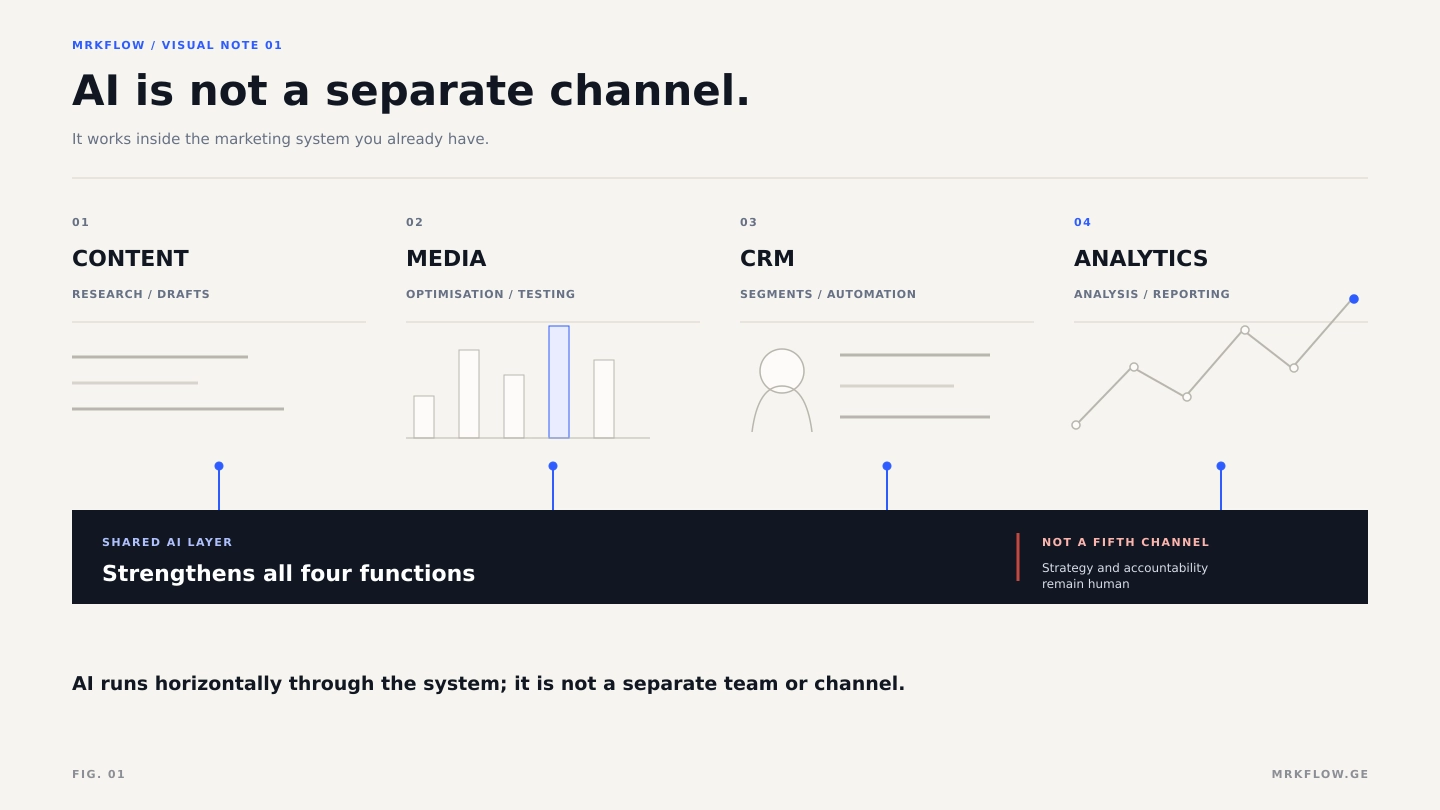
AI marketing is the part of marketing work where a machine-learning model carries the decision or the execution: analyzing data, segmenting audiences, personalizing messages, drafting content and automating repeatable processes. AI can support the channels and processes you already run. Its costs, including tools, integration and review time, should be included in the relevant work plan.
That distinction is not a matter of wording. Treat AI as its own project and there is nowhere to measure its result, so six months later the question "what did it give us" has no answer. Put it inside a process you already run and the answer becomes plain: you reached the same result in less time, or you did not.
What AI actually does in marketing
Five things that work today rather than five things that are promised.
- Data analysis. Processing large volumes of behavioral and advertising data, finding patterns and forecasting. Models can process large datasets quickly, but the quality of the analysis depends on the data, the task and verification of the output.
- Segmentation and personalization. Splitting an audience by behavior rather than demographics alone, then matching a message to each group.
- Content production. First versions of text, visuals and video. "First" is the operative word: the model solves the blank page, not the decision to publish.
- Automation. Repeatable chains: lead qualification, email sequences, chatbots, rule-based budget shifts across campaigns.
- Reporting. Turning data into readable text, spotting anomalies, and a job that can eat hours: rebuilding the same weekly table by hand.
What AI marketing is not
Three confusions that cost money.
It is not a strategy. A model answers the question you ask it. If you do not know who you are speaking to and why they should choose you, AI will multiply that ignorance faster and more convincingly than you could by hand.
It is not a replacement for the team. What changes is the shape of the work, not whether people are needed. Less time goes on execution and more on decisions, editing and verification. Without sufficient review, errors can create rework and reduce the time saved.
It is not a source of truth. A language model produces a convincing sentence, not a checked fact. Numbers, dates, legal wording, a competitor's price: every one of those has to be verified separately.
Where it corrodes trust
One practical rule helps here: give the model what is repeatable and checkable, and leave the person what is singular and accountable.
Brand voice, the promise made to a client, the response to a crisis, pricing: these are where generated text is felt immediately, and the loss is bigger than the text. On the other side, the first draft of a hundred product descriptions or two hundred ad variations is exactly the case where doing it by hand is a luxury.
Where to start
A week is enough to move from promises to measurement.
- Write down where the time goes. Log for one week which work takes how many hours. The list shows how much of the time goes on execution rather than thinking.
- Pick one repeatable task. Not the hardest one, the most frequent one. Frequency becomes leverage; difficulty becomes risk.
- Measure twice. How long it took before and how long it takes now, at the same quality. The quality half is not optional, or the saved hour has merely moved into fixing things.
- Write the rule down. When you publish and when you do not, who checks the facts, where it is disclosed that a model helped. A rule that is not written down dissolves the moment the team grows.
For the deeper version (where AI compounds value inside a working process and where it quietly destroys trust), we wrote that separately: AI in the marketing workflow.
How widespread this actually is
AI marketing is easy to dismiss as vendor noise and easy to overstate. Two independent measurements put a floor and a ceiling on the claim.
On the audience side, Pew Research Center's February 2026 survey of 5,119 US adults found that about half now use AI chatbots (up from a third in 2024) and roughly four in ten use them to look things up. These findings describe US adults. They show the relevance of AI tools in that market, but a business should assess adoption among its own audience before applying the figures locally.
On the production side, the best evidence is a controlled trial rather than a survey. Dell'Acqua and colleagues randomised 758 consultants at Boston Consulting Group. On tasks inside the model's competence, the AI group completed 12.2% more work, 25.1% faster, and scored more than 40% higher on quality, with the largest gains going to the people who had previously scored lowest.
And the number that gets left out of the sales pitch
The same experiment included a task placed deliberately outside the model's competence, where the plausible answer was wrong. Consultants using AI were 19 percentage points less likely to get it right than consultants working without it.
This finding matters for a marketing team, because it names the actual risk. The danger is not a model that obviously cannot do something: people notice that immediately. It is the edge case where a wrong answer arrives in exactly the same confident, fluent form as a right one. That is not solved by "being careful"; it is solved by deciding in advance which tasks get a verification step and who signs it.
What this means for a marketing budget
- The productivity gain is real and it is largest at the bottom. If your bottleneck is a small team producing routine volume, this is where the money is, not in a strategy tool.
- The gain is on tasks with a checkable answer. Anything whose quality can only be judged months later by a market is not a task where speed helps you.
- Verification is a line item, not a virtue. A workflow should budget time for verification. The study's 19-point difference illustrates a risk on a specific task; it is not a forecast of the loss in every unchecked workflow.
A short test for any AI marketing pitch
Ask the vendor which of the two zones their product operates in, and what happens on the boundary. A serious answer names specific tasks and describes a verification step. An answer about transformation and the future is a description of the 19 points, from the side that does not have to pay for them.
Sources
What this is based on
- Americans and AI: chatbots, smart devices and views on impact
- Navigating the Jagged Technological Frontier: Field Experimental Evidence of the Effects of AI on Knowledge Worker Productivity and Quality
- Artificial Intelligence Risk Management Framework: Generative Artificial Intelligence Profile (NIST AI 600-1)
- Creating helpful, reliable, people-first content
- Set up automated rules
FAQ
Frequently asked questions
What is AI marketing in simple terms?
AI marketing is the use of artificial intelligence inside marketing work: analyzing data, segmenting audiences, personalizing messages, drafting content and automating repeatable processes. It is not a separate channel but a layer working inside the channels you already run.
Will AI replace marketers?
No. What changes is the shape of the work: less time on execution, more on decisions, editing and verification. A model answers the question you ask it, and asking the right question is still a human job.
Where should a small business start?
Log for one week where the time goes, pick the single most frequent repeatable task, and measure how much less time it takes at the same quality. One measured task beats five unfinished experiments.
Where is AI not worth relying on?
Wherever the output is singular and the accountability personal: brand voice, the promise made to a client, crisis response, pricing, and any fact that needs verifying such as a number, a date or a legal provision.

Free audit
Now let's look at your marketing.
Send us your website or main social profile. We will review the publicly available material and send a written assessment of strengths, issues and priorities.
Request free auditRead next
Terms used here: Marketing automation AI in marketing Tone of voice