
Product & Automation
AI in marketing workflows: useful tasks, risks and review

Deciding how to use AI in marketing starts with individual tasks. Consider the quality you need, the time and cost involved, the information the tool can use and the consequences of an error. Some tasks suit automation; others require more direct human judgment.
For each task, ask: can AI help us produce useful work, and how will we verify the result? A faster draft has value only if the team can check and use it.
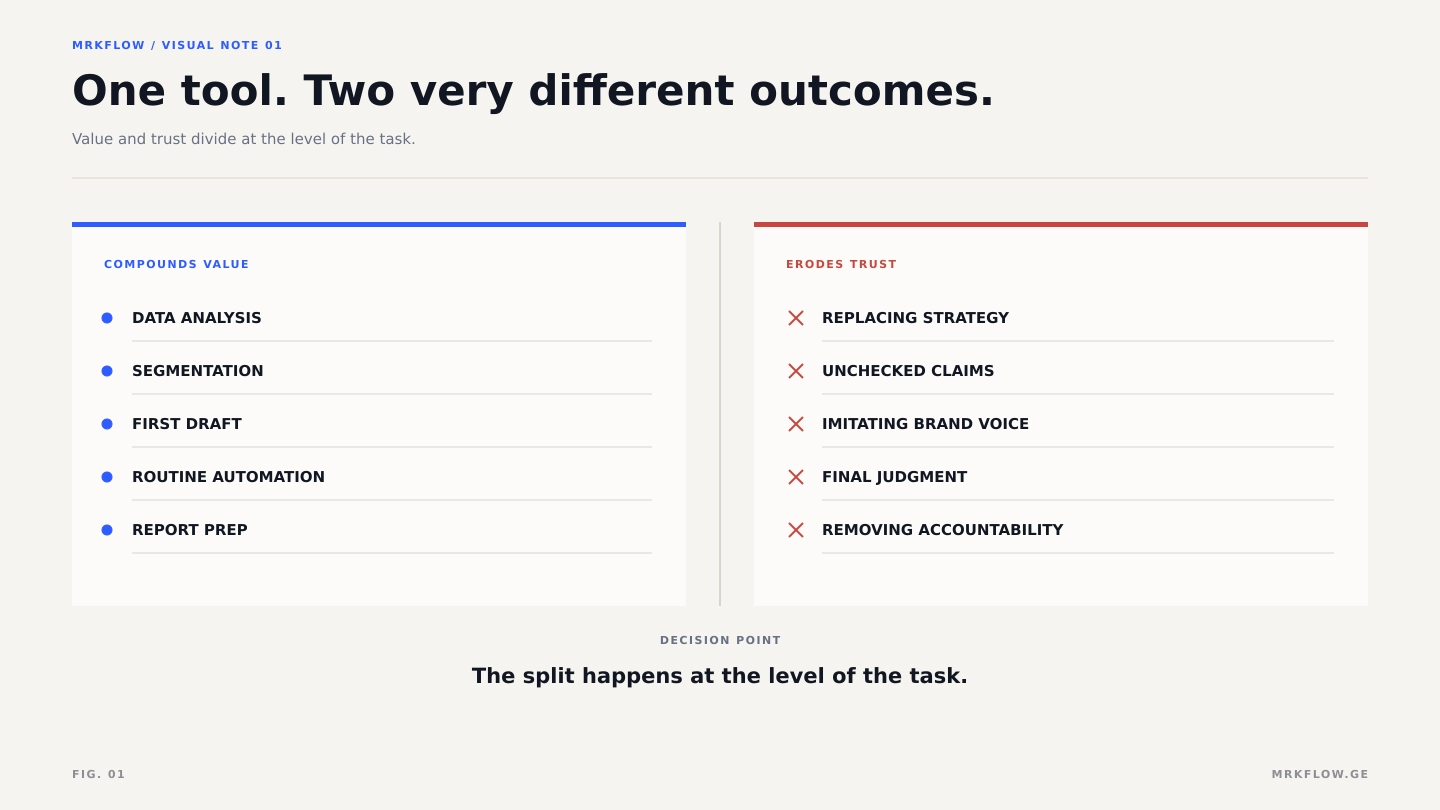
Where AI can help
- Research and synthesis. AI can organize material about markets, competitors and audience feedback. The strategist still needs to check sources, assess relevance and develop the conclusions.
- First drafts. Reports, briefs, proposal outlines and text variations can begin with an AI-assisted draft. An editor develops the material using the business's actual information and the requirements of the brief.
- Repeatable operations. Reporting, tagging, routing inquiries and preparing checklists may benefit from marketing automation. Choose between conventional rules and AI according to the task, then measure time saved and error rates.
- Analysis of large volumes of text. AI can help identify recurring themes in reviews and comments. Check examples against the original material and assess whether the summary fairly represents the dataset.
Risks that require review
- Publishing without review. An AI draft may be inaccurate, generic or inconsistent with the brand's voice. Check both meaning and tone before making it public.
- Fabricated evidence. Invented statistics, testimonials and unsupported claims can mislead readers and damage trust. Verify evidence before using it in marketing.
- Delegating the final strategy. AI can help organize research and compare messages. People still need to assess audience needs, choose a position and substantiate the business's advantages.
Our working rule
Our workflows assign responsibility before the work begins. People define the task and approve the result; AI can assist with execution. A responsible editor checks facts, quality and consistency with the brief before publication.
A defined reviewer makes approval traceable. The team should know who checked the material, what still needs confirmation and who can authorize publication. Unclear responsibility increases the risk of releasing unchecked content.
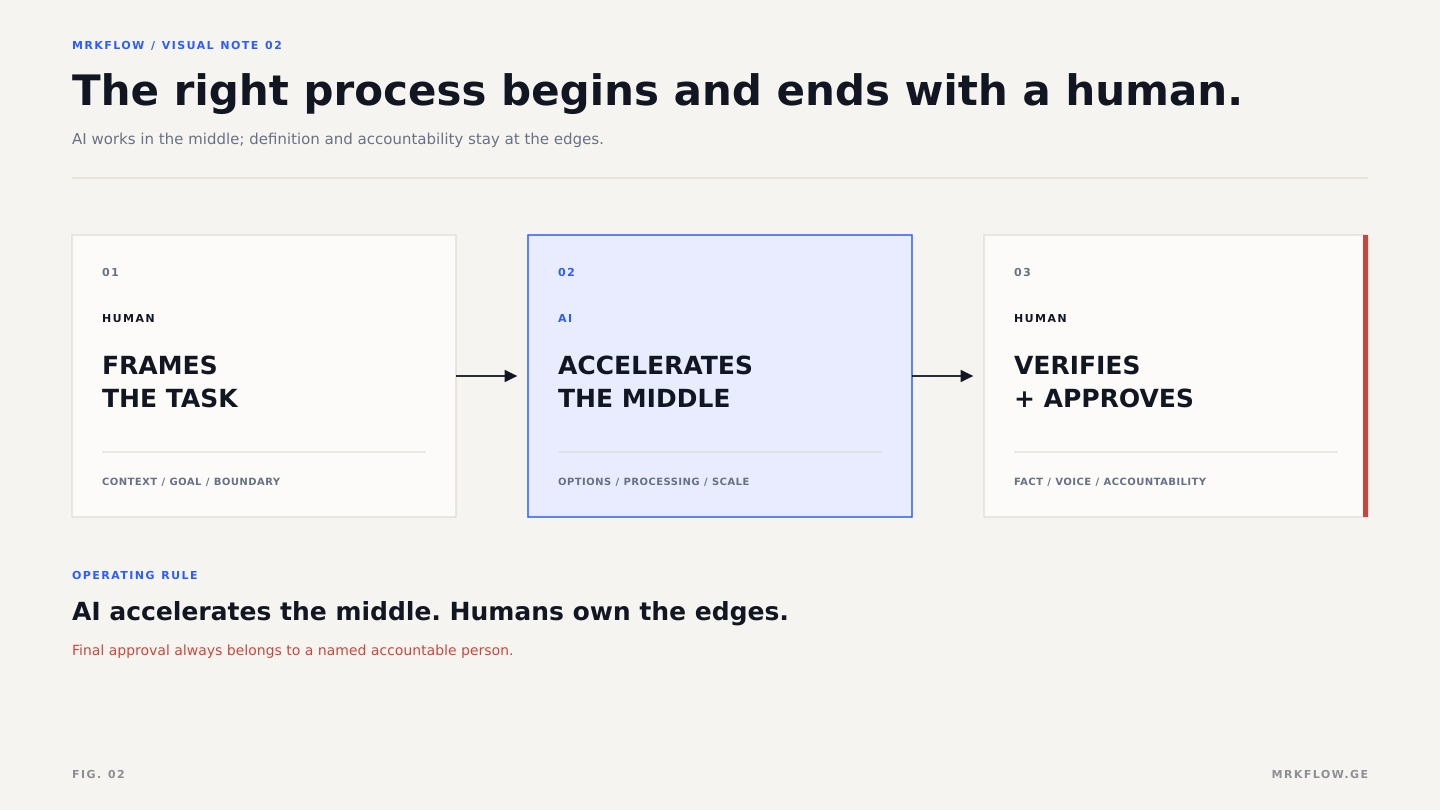
List the marketing tasks your team repeats each week. Identify the brief, execution and approval stages, then assess where AI could help and who would check its output. Compare the expected time saved with tool costs, integration work and the review effort.
What the experiment shows about AI performance
A controlled field experiment helps explain why AI should be evaluated for each task. It did not test our exact review sequence; that sequence is our working rule.
In 2023 Dell'Acqua and colleagues ran a randomised trial with 758 consultants at Boston Consulting Group, about 7% of the firm's individual-contributor consultants. On tasks that sat inside the model's competence, consultants with AI completed 12.2% more tasks, 25.1% faster, and were graded more than 40% higher on quality. The gain was largest for the people who had been scoring lowest.
Then the same study gave them a task deliberately placed outside the model's competence, one where the plausible answer was the wrong one. Consultants using AI were 19 percentage points less likely to reach the correct solution than consultants working without it.
How to interpret the result
The 19-percentage-point difference describes performance on that particular task in the experiment. It does not predict the outcome of every AI-assisted task. The finding is a reason to test whether a tool suits the work and to assess accuracy separately from how fluent an answer sounds.
We use these findings to inform our review process. Fluent output can still be wrong, so the reviewer checks the underlying facts and reasoning against independent evidence. The level of review depends on the task and the consequences of an error.
How we organize human review
- Define the task and review criteria. Set out the purpose, audience, available sources and requirements before preparing the draft.
- Use AI where it helps execution. This may include organizing research, preparing drafts or producing variations. Choose tasks for which the team has a workable way to assess the output.
- Assign a responsible reviewer. Record who checks the material and who approves publication. These responsibilities should be clear for each deliverable.
- Check factual claims. Verify statistics, quotations and other claims against suitable sources. Correct or remove statements that cannot be supported.
What we will not do with it
We do not use models to impersonate a named person, fabricate evidence or publish unreviewed output, and we tell clients where AI was involved. A person remains responsible for checking the work. The study reinforces the need to test AI on the actual task; its measured effect should not be treated as a prediction for every workflow.
Sources
What this is based on
- Navigating the Jagged Technological Frontier: Field Experimental Evidence of the Effects of AI on Knowledge Worker Productivity and Quality
- Artificial Intelligence Risk Management Framework: Generative Artificial Intelligence Profile (NIST AI 600-1)
- Federal Trade Commission Announces Final Rule Banning Fake Reviews and Testimonials
- FTC Policy Statement Regarding Advertising Substantiation
FAQ
Frequently asked questions
How should AI fit into a marketing workflow?
Use AI for tasks where it provides useful support and the result can be checked. People define the brief, review facts and quality, and approve the final material. Set the depth of review according to the task and the consequences of an error.
Which marketing tasks can AI support?
Examples include organizing research, analyzing customer feedback, preparing drafts, producing variations and supporting reporting. The value depends on the input data, the tool and the team's ability to check the result.
Which responsibilities should remain with people?
People should remain accountable for strategic decisions, verification of facts and publication. AI can contribute to these tasks, but material issued in the brand's name needs a responsible person to check and approve it.
How can we make AI-assisted content more specific?
Provide a clear brief, relevant facts, audience context and real constraints. Then edit the draft using the business's experience, check its claims and remove generic material that does not help the reader.

Free audit
Now let's look at your marketing.
Send us your website or main social profile. We will review the publicly available material and send a written assessment of strengths, issues and priorities.
Request free auditRead next
Terms used here: Marketing automation AI in marketing Creative brief