
Digital Marketing
SEO and GEO: visibility in search and AI answers

For twenty years, being found meant one thing: rank in the search results. Now a growing share of buying questions is answered by AI assistants that read the web and reply with a synthesis, sometimes with citations, sometimes without. The industry named the new discipline GEO, generative engine optimization, and promptly started selling it as a replacement for SEO.
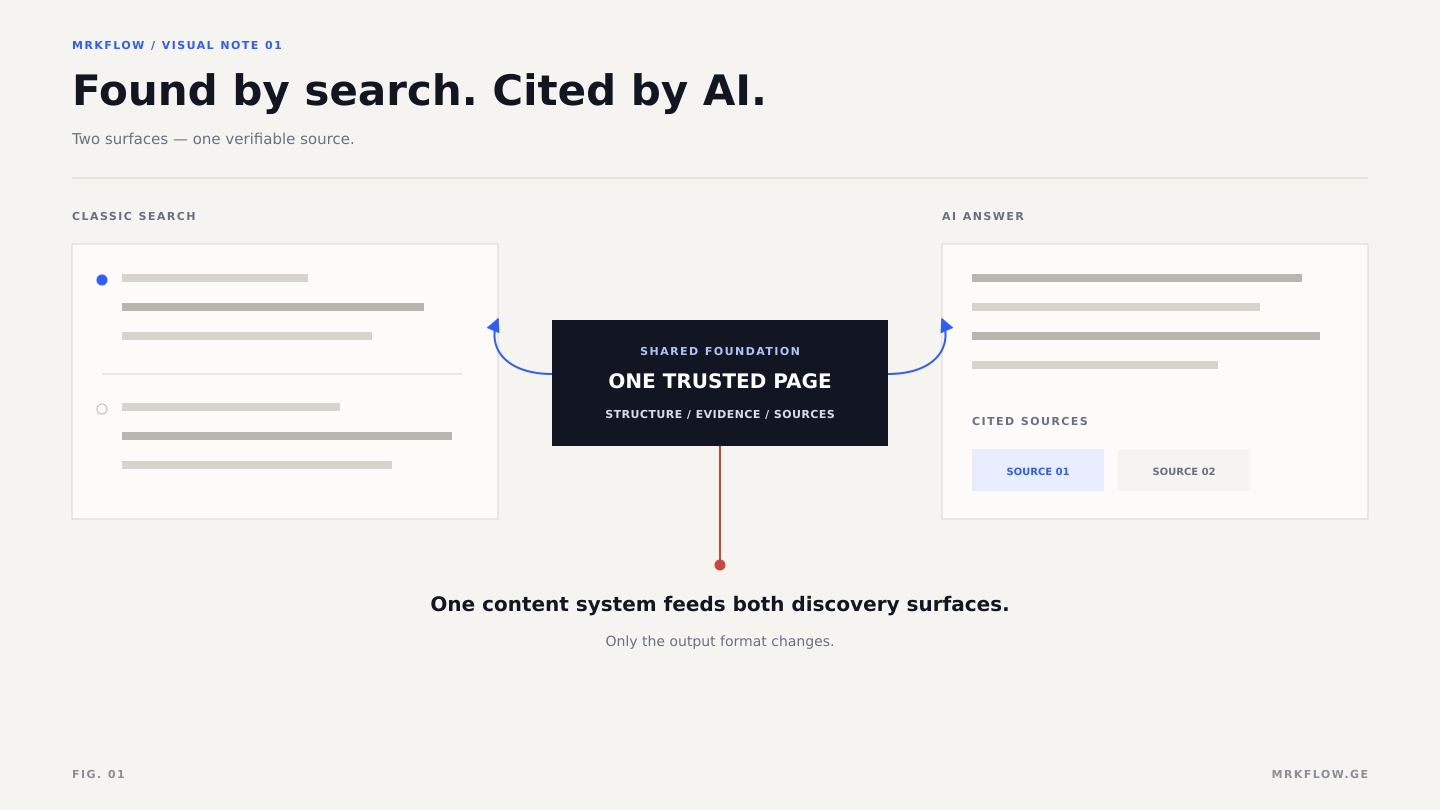
It is not a replacement. It is a second surface fed by the same underlying asset: content that machines can verify, structure they can parse, and authority they can trace.
What stays the same
Start with the reader's needs and the site's technical basics: useful content, accessible pages and accurate information about the business. Google says standard SEO practices remain relevant to its AI search features. Other services may use different systems, so avoid treating one set of tactics as a universal formula.
What actually changes
Three things shift when the reader is a model rather than a person scanning ten blue links.
Give a clear answer. State the main point early when that helps the reader, then add the evidence and detail it needs. This is a writing principle, not a guarantee that an AI service will cite the page.
Use structure to help readers. Headings, definitions, tables and relevant FAQs make information easier to find. Choose the format that suits the subject; AI visibility does not require every answer to fit into a standalone paragraph.
Check how the business is described elsewhere. Relevant reviews, comparisons and industry coverage can help people assess a brand. Keep the information accurate, and pursue coverage for its value to the audience rather than assuming every mention will influence AI answers.
The playbook we run
In our SEO and GEO optimization work, we review each page for content and technical clarity. Does it answer the reader's question accurately and in the brand's voice? Do the title and headings describe the content, can search systems access it, and is the information about the business consistent?
We track search positions and clicks alongside mentions or citations for a defined set of relevant AI queries. Record the service, date and test conditions, because answers vary. Referral traffic and resulting inquiries add useful evidence where they can be measured.
Plan search and AI visibility together where the work overlaps. Use one content process with clear owners, evidence checks and regular updates, and reserve separate work for a specific, justified need.
How much of search this actually is, in numbers
The honest starting point is that nobody outside the platforms knows the whole picture, and most published figures come from vendors selling a solution to the problem they are describing. Two independent measurements are worth more than a dozen of those.
The first is behavioral. In March 2025 the Pew Research Center tracked the actual browsing of 900 US adults across 68,879 Google searches, 12,593 of which returned an AI summary. When a summary was present, users clicked a normal result in 8% of visits; when it was absent, 15%. Clicks on a source cited inside the summary: 1%.
In this study, searches with AI summaries had a lower click rate than searches without them. That is an observed association, not a measured traffic loss for every cited page. Citation should therefore be assessed alongside referral traffic and business outcomes, not sold as a guaranteed source of visits.
The second is adoption. Pew's February 2026 survey of 5,119 US adults found about half now use AI chatbots, up from a third in 2024, and roughly four in ten use them to look things up. These findings show substantial adoption. They do not measure the referral traffic a particular business might receive.
So what is a citation worth?
A citation can make a brand visible and may lead to a visit, but neither outcome guarantees an inquiry or a sale. Assess whether the description is accurate, whether the audience is relevant and whether any resulting activity supports the business goal.
Measure the parts you can observe: AI referral sessions where identifiable, resulting inquiries, and the accuracy of brand mentions in a repeated set of queries. Keep these measures separate, because visibility and visits answer different questions and no single measure captures the whole picture.
What the research says actually moves the needle
There is one peer-reviewed study worth reading rather than repeating: Aggarwal and colleagues at KDD 2024 built a benchmark of user queries and tested nine content changes against real generative engines. In their experimental setting, some changes increased a source's visibility in generated answers by up to 40%. This is a study result, not a forecast for every website or current AI service.
The finding under the headline matters more. What worked was adding quotations from credible sources, citing statistics, and adding references: content changes that make a passage verifiable. What did not work reliably was keyword stuffing, which is the tactic the SEO industry reached for first. And the effect sizes varied by domain, meaning there is no single recipe to buy.
These findings support a practical starting point: provide specific information, attribute claims and make the evidence easy to check.
The practical brief
Start with these four content principles:
- Make explanations clear in context. Define important terms and give readers enough detail to understand the answer. Do not force every subject into a fixed paragraph length.
- Name the subject when needed. Use a specific term when a pronoun would leave the reader unsure what the sentence refers to.
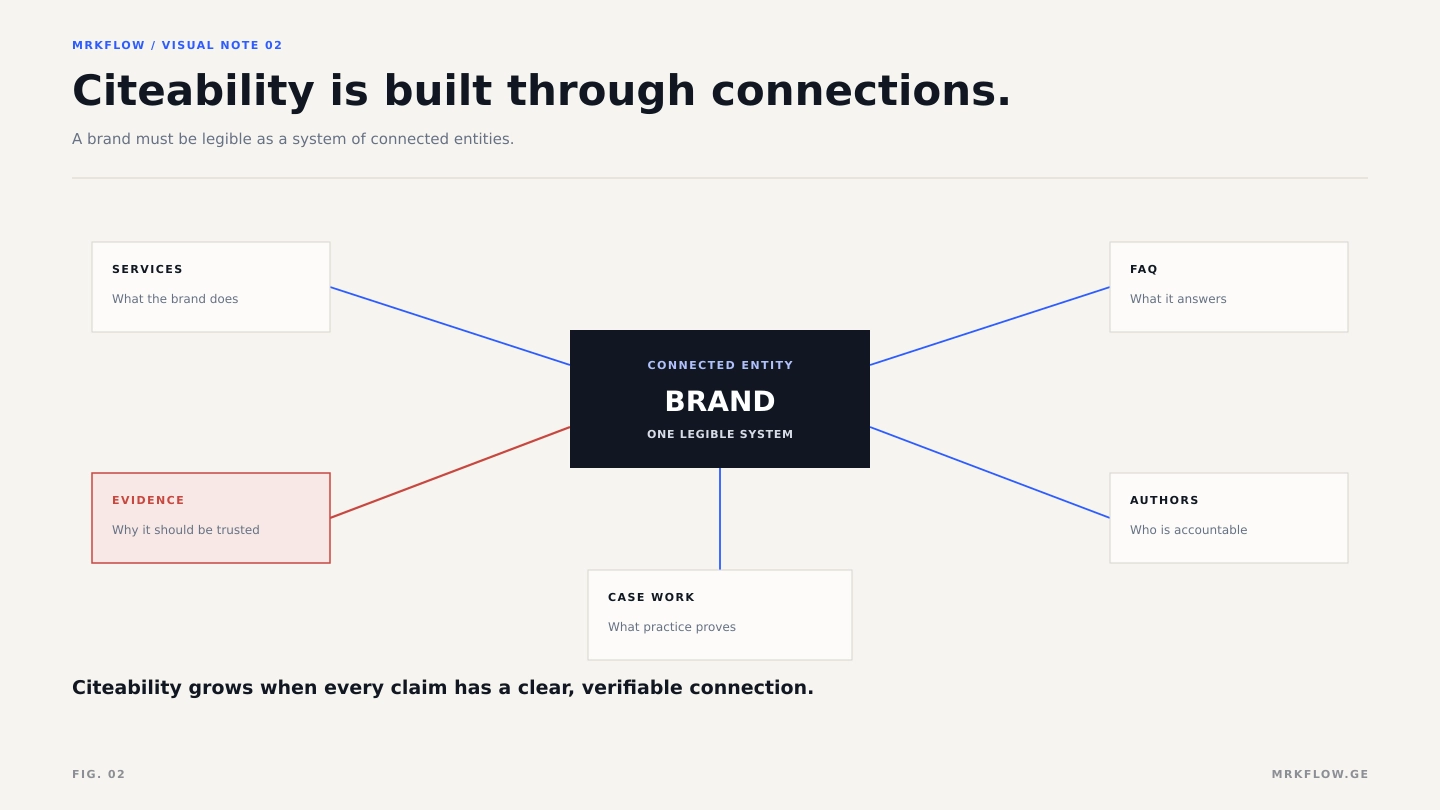
- Support claims with the right evidence. Cite reliable external sources for research and statistics, and document first-hand findings clearly. Explain what each source supports and where its limits are.
- Make the entity unambiguous. Who you are, where you are, what you do, in structured data as well as in prose, so a model does not have to infer it from navigation labels.
Use these principles as a starting point, and judge additional recommendations against evidence, official platform guidance and the needs of the audience.
FAQ
Frequently asked questions
What is the difference between SEO and GEO?
SEO aims to improve a site's visibility in search. GEO is a term used for work focused on visibility in AI-generated answers. They overlap, and neither guarantees rankings, citations or clicks.
Does GEO replace SEO?
No. For Google's AI search features, normal SEO guidance applies and there are no special AI files or schema requirements. Build useful, accessible pages and assess any additional recommendations for other services against their own guidance.
How do you get cited by an AI answer engine?
There is no guaranteed method. Publish useful, accurate information, make sources clear where claims need evidence, and check that the relevant service can access your pages. No special paragraph format or markup can ensure a citation.
Can you measure GEO results?
You can track mentions and their accuracy in a defined set of queries, identifiable referral visits and resulting inquiries. Record the service and test conditions, and explain the limits: answers vary, and a single score cannot describe visibility across all AI services.

Free audit
Now let's look at your marketing.
Send us your website or main social profile. We will review the publicly available material and send a written assessment of strengths, issues and priorities.
Request free auditRead next
Terms used here: GEO (generative engine optimization) SEO (search engine optimization) Structured data Creative brief Content system Keyword